
Beyond the Demo: From Technology to Real-World Use

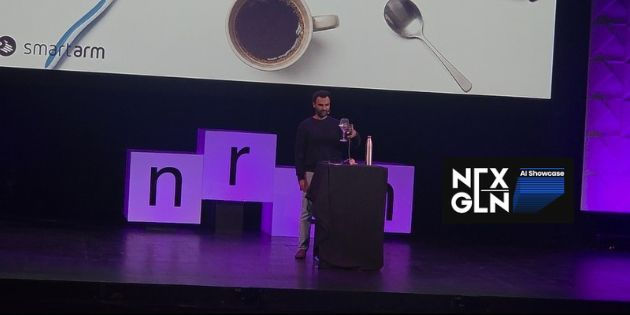
Before attending Elevate Festival 2026, one of the questions I had was simple: what happens after a technology makes a good first impression?
I was interested in the difference between a product that looks impressive in a demo and one that people can actually understand, use, and find valuable.
After attending the festival, that question became more specific.
Two sessions in particular made me think less about what technology can technically do and more about how it fits into the real world: Spatial AI and SmartArm.
From Intent to Execution
One session focused on Spatial AI in the built environment.
The speaker described Spatial AI as a translation layer between design and engineering intent and something that can actually be procured and constructed.
What stayed with me was not simply the idea that AI could make parts of the design process faster. I was more interested in how technology could reduce the friction between an idea and its execution in a complex physical environment.
The examples presented included an elementary school, a hospital, and a hyperscale data centre. The speaker shared examples of time savings and material efficiencies, but I saw those figures mainly as examples of a broader point.
A technically strong idea still has to work within real constraints.
In construction, that includes precision, safety, codes, materials, workflows, and experienced practitioners. The speaker also emphasized that AI alone was not the answer. The combination of experienced people and AI mattered.
That idea felt relevant beyond construction.
For physical technology, including the kinds of customer experiences we think about through NexGen AI Showcase, technical capability is only one part of the product. The technology still has to work within the environment where people will actually encounter and use it.
When Technology Adapts to the User
The SmartArm session made the user side of this question even clearer.
SmartArm presented a vision-powered bionic arm that uses a camera and AI to recognize an object and select an appropriate grip.
One idea from the presentation stayed with me: the device should adapt to the user rather than asking the user to adapt to the device.
That sounds simple, but it changed the way I thought about interaction.
The question is not only whether the technology is capable of performing a task. It is also how much effort the user has to make to understand it, control it, or change their own behaviour in order to use it.
The presentation included the story of a user named Gary, who had struggled with previous prosthetics and was able to pick up a cup and drink shortly after trying SmartArm.
I would not generalize from one example, but it made the design principle very easy to understand.
The connection to NexGen is not that a transparent display and a prosthetic device are similar products. They are not.
What connected the two for me was the question of interaction:
Are we asking users to learn how to interact with the technology, or are we designing the technology to respond naturally to the user?
A More Specific Question for NexGen
Before Elevate, I was thinking broadly about customer attention and whether technology could create an interesting experience.
After these sessions, I find myself asking something more specific.
Once the technology gets someone’s attention, how easy is it for that person to understand what to do next?
For NexGen AI Showcase, this moves the conversation beyond visual impact. It raises questions about interaction, context, and whether the technology feels natural within the customer journey.
What I brought back from Elevate was not a new formula for designing technology.
It was a clearer distinction between technical capability and real-world usability.
And that leaves me with a more practical question for the next stage: how do we reduce the distance between the two?


Comments